
Corporate event planning shouldn’t start with “Should this be in-person or virtual?” It should start with “What do we need to accomplish?”
Too many organizations approach corporate event planning backwards. They commit to a format before understanding their objectives, then spend months trying to force a square peg into a round hole. The result? Events that look polished but fail to deliver meaningful results.
At illuminate EVENTS, we specialize in strategic corporate event planning that delivers measurable outcomes. Here’s what we’ve learned about selecting event formats that actually work.
Why Corporate Event Planning Should Start With Objectives, Not Format
The corporate events landscape has shifted dramatically. According to recent industry data, 60% of events now take place in-person, 35% virtually, and 5% in hybrid formats. But here’s what those numbers don’t tell you: successful corporate event planning doesn’t start with format percentages. It starts with outcomes.
Research shows that 78% of organizers identify in-person events as their organization’s most impactful marketing channel. Yet that same research reveals something crucial—the format matters far less than strategic alignment. Organizations that define clear objectives before choosing a format report significantly higher ROI and attendee satisfaction.
The mistake we see repeatedly in corporate event planning? Companies choosing formats based on habit (“we’ve always done it this way”) or convenience (“virtual is cheaper”) rather than strategic fit.

Understanding Each Format’s True Strengths in Corporate Event Planning
Let’s cut through the noise. Each format has distinct advantages when matched correctly to your goals.
In-Person Events: When Face-to-Face Corporate Event Matters Most

In-person gatherings excel at creating the kind of deep connections that can’t be replicated on screen. These events work best when your objectives include:
Leadership Alignment and Strategic Planning
When executives need to hash out complex decisions or align on organizational direction, nothing beats being in the same room. The side conversations during breaks, the ability to read body language, the focused attention away from daily distractions—these elements drive the candid discussions that move companies forward.
Culture Building and Team Cohesion
Want to strengthen your company culture or improve cross-departmental collaboration? In-person events create shared experiences that build genuine relationships. Research indicates that 83% of events planned for 2025 will include an in-person component precisely because organizations recognize this value.
High-Touch Client Engagement
When the relationship matters as much as the transaction, face-to-face events demonstrate investment in ways digital formats simply cannot. Product demonstrations, immersive brand experiences, and relationship-building dinners require physical presence to maximize impact.
Virtual Events: Scale, Accessibility, and Efficiency

Virtual events have evolved far beyond emergency pandemic solutions. Today’s virtual platforms deliver sophisticated experiences that work exceptionally well for:
Knowledge Sharing and Training at Scale
Need to train 500 employees across ten provinces? Virtual formats remove geographical and logistical barriers while maintaining engagement through interactive features. Organizations report that virtual formats can boost lead capture by up to 30% compared to traditional approaches.
Regular Touchpoints and Updates
Quarterly town halls, monthly all-hands meetings, and ongoing professional development programs benefit from the efficiency of virtual delivery. Teams can participate without travel time, and sessions can be recorded for on-demand access.
Cost-Effective Lead Generation
When your primary goal is reaching as many qualified prospects as possible, virtual events offer unmatched scalability. The virtual events market is projected to reach $236.7 billion in 2025, driven largely by organizations recognizing this format’s lead generation potential.
Hybrid Events: Bridging Both Worlds in Corporate Event Planning (When Done Right)
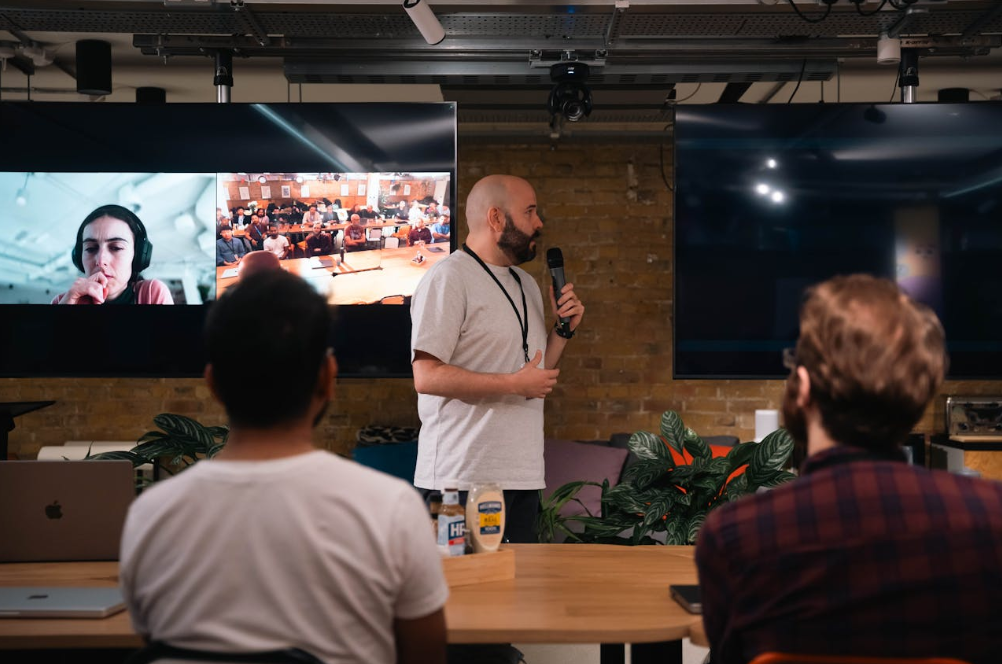
Corporate event planning hybrid format with in-person and virtual attendees
Hybrid events represent the most complex format—and when executed professionally, the most versatile. Hybrid formats grew by 18% globally in 2025, but here’s the critical nuance: Forrester research indicates that 38% of event organizers report hybrid events require more preparation time than dedicated in-person or virtual events—underscoring the importance of professional execution.
The key word there is “professionally.” A poorly executed hybrid event creates a disjointed experience that satisfies neither audience. Done well, hybrid events:
- Maximize Reach While Maintaining Impact: Combine the relationship-building power of in-person attendance with the accessibility of virtual participation
- Create Multiple Revenue Streams: Offer tiered pricing models that expand your audience beyond geographic constraints
- Extend Event Value: Provide on-demand content that continues driving engagement long after the live event concludes
At illuminate EVENTS, we approach hybrid events with equal attention to both audiences. This means dedicated engagement opportunities for virtual attendees, not just passive streaming. It means technology that seamlessly connects both groups. And it means content designed from the ground up for dual delivery.
Our Strategic Corporate Event Planning Framework
Here’s the process that consistently delivers results for our clients:
Step 1: Define Clear, Measurable Objectives
Start with brutal honesty about what success looks like. Not “we want a great event” but specific outcomes:
- Generate 150 qualified sales leads
- Improve employee engagement scores by 20%
- Secure commitments from 75% of attending clients
- Launch new product to 500 target decision-makers
Step 2: Identify Your Critical Audience
Who absolutely must participate for this event to succeed? Where are they located? What are their preferences and constraints?
A leadership retreat for your executive team has different audience considerations than a customer conference for 1,000 clients across North America. Format decisions flow naturally from audience analysis.
Step 3: Determine Required Engagement Level
Different objectives demand different levels of interaction:
- High-touch engagement (workshops, strategic planning, team building) → In-person
- Moderate engagement (training, presentations with Q&A, panel discussions) → Virtual or hybrid
- Broadcast communication (announcements, updates, recognition) → Virtual
Step 4: Select the Format That Serves Your Goals
Only at this point does format selection make sense. And often, the right answer becomes obvious based on your objectives, audience, and engagement requirements.
Step 5: Design the Experience Around Outcomes
Once you’ve selected your format, every element should ladder up to your defined objectives. From the agenda structure to speaker selection to follow-up strategy, purposeful design separates mediocre events from transformational ones.
Common Corporate Event Planning Mistakes (And How to Avoid Them)
Going Hybrid by Default
Hybrid isn’t always better. Sometimes it’s just more complicated. Choose hybrid only when you genuinely need to serve two distinct audiences with different participation constraints.
Choosing Virtual Only to Save Money
Cost savings are real, but they’re meaningless if you don’t achieve your objectives. Some goals simply require in-person interaction. Trying to force them into a virtual format guarantees failure.
Forgetting Follow-Through
The format you choose should enable your post-event strategy. In-person events drive immediate action—on-site meetings turn into closed deals, conversations happen organically, and relationships deepen in ways virtual simply can’t replicate. Virtual formats work for broader reach and content accessibility, but when your goal is conversion and lasting impact, live events are the strategic choice.
What Great Execution Looks Like
Format matters, but execution quality matters more. We’ve seen exceptional in-person events that transformed organizations and virtual events that generated millions in pipeline. We’ve also seen expensive in-person gatherings that wasted everyone’s time and virtual events where half the audience disappeared after ten minutes.
The difference? Professional execution aligned with clear objectives.
For In-Person Events:
Purpose-driven agendas, thoughtful venue selection, networking opportunities that facilitate specific connections, and production quality that keeps people engaged throughout.
For Virtual Events:
Technology that works flawlessly, interactive elements that maintain attention, content broken into digestible segments, and clear calls to action that drive desired behaviors.
For Hybrid Events:
Dedicated resources for both audiences, technology infrastructure that seamlessly connects participants, and content design that serves both groups equally well.
The Bottom Line: Start With Why
The most successful corporate events we’ve produced share one characteristic: their organizers knew exactly what they needed to accomplish before making any format decisions.
Research by Bizzabo shows that 70% of event organizers struggle to measure and demonstrate ROI effectively—underscoring why strategic planning that begins with clear objectives rather than format preferences is essential for proving event value.
In-person events create unmatched opportunities for relationship building and deep engagement. Virtual events offer scale, accessibility, and efficiency. Hybrid events bridge both approaches when your objectives require reaching diverse audiences with different participation needs.
But none of these formats guarantee success. What guarantees success is strategic clarity about your goals, followed by professional execution that delivers against those goals.
Whether you’re planning a corporate leadership retreat, town hall, conference, or product launch, the format should serve your objectives—not the other way around.
At illuminate EVENTS, we begin every engagement by understanding what you’re trying to achieve. Only then do we recommend the approach that will actually work. Because in event planning, like business strategy, execution quality matters more than the medium.
Need guidance on your next corporate event? Connect with our team to discuss your objectives and explore which format will deliver the results you need.